Skip to content

Lash Glue and Humidity: How to Get Better Retention in Any Room
October 21, 2026 by The Lash Professional.

If your retention is great in one season and falling apart in the next, the culprit is often the air in your lash room, not your technique. Lash glue and humidity are tied together, and once you understand how, you can pick the right adhesive, set up your room for it, and keep your clients' sets lasting until their fill.
This guide covers why humidity changes the way lash glue behaves, how to read your own lash room, what to do when it's too dry or too humid, and which glue fits which conditions.
Why humidity matters for lash glue
Eyelash extension adhesives are cyanoacrylate glues. They cure when they react with moisture: the water in the air (and on the surface of the lash) is what sets the reaction off. Adhesive makers describe it the same way: curing needs moisture as a catalyst, so in very dry air the reaction slows down.
So the same bottle of glue can act like two different products depending on the room. That's why one artist swears by a glue and another can't get it to work: they're often lashing in very different air.
When the room is too dry
- The glue cures slowly, so the bond stays soft longer after placement.
- Extensions can stick to each other or to neighboring natural lashes before the glue sets.
- Sets can feel fine when the client leaves but lose lashes sooner than you'd expect.
When the room is too humid
- The glue cures too fast. A drop can skin over before you place the extension.
- A bond that starts setting before it's in full contact with the natural lash is a weaker bond.
- Your glue drop on the stone thickens faster than usual.
Lash glue and humidity in Arizona
Here in Arizona, dry air is the everyday challenge for most of the year, and it drops even further indoors when the heat or A/C is running. Summer monsoon season can then bring sudden humid days. If you lash in Arizona (or anywhere with big seasonal swings), expect your glue to behave differently in different months, and plan for it instead of fighting it.
How to check your lash room
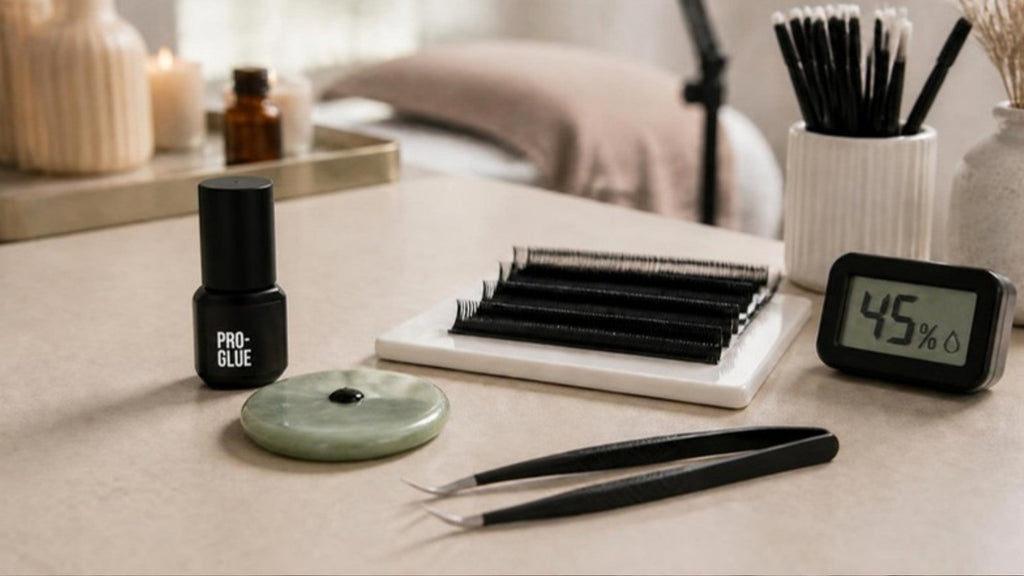
- Get a hygrometer. A small digital humidity monitor costs very little. Put it at your lash station, at the height where you work, not across the room.
- Check it before every client. Humidity can change through the day as the A/C or heat cycles.
- Write it down. Note the reading on days your retention is great. That number is your target with your current glue.
- Keep it steady. Big swings during the day cause more trouble than any one exact number.
Too dry? Try this
- Run a humidifier near (not on) your station, and turn it on early so the room is ready before the client lies down.
- Choose a faster-drying glue so the bond can still set well in dry air.
- Use fresh glue drops often. A drop that has been sitting out on your stone cures differently than a new one.
- Keep your adhesive bottle capped between drops so the glue in the bottle stays consistent.
Too humid? Try this
- Use a dehumidifier or A/C to bring the room down.
- Pick a glue with a little more working time.
- Dip only the tip of the extension so you aren't carrying extra glue that sets before placement.
- Place each lash right away; don't let the glue sit on the extension while you isolate.
A quick pre-client routine
- Check the hygrometer and adjust the humidifier or A/C.
- Shake your glue as the bottle directs and put out a fresh drop.
- Do one or two test placements and watch how fast the glue sets.
- If it's setting too fast or too slow for your speed, adjust the room or switch glues before you start the full set.
Which TLP glue fits your room
- Pro Eyelash Extension Glue: 0.5-second dry time and works in any humidity range. The pick when your room's humidity changes from day to day, or season to season.
- N1 Eyelash Extension Glue: about a 1-second average dry time, for classic and volume sets.
- Clear Eyelash Extension Glue: about a 1-second average dry time with a light, liquid consistency.
- Sensitive (N5) Eyelash Extension Glue: about a 5-second dry time with a light formula, a good fit for newer lash artists who need more working time.
Not sure which one to choose? Email support@thelashprofessional.com or call (480) 588-5160 and tell us how your room runs. Orders of $149 or more ship free.
When it isn't the humidity
If your room is steady and retention is still poor, look at the other usual causes: lash prep (oils and makeup left on the natural lash), isolation, how much glue you're using, placement on the natural lash, and client aftercare. Our Lash Retention Course Online is made for artists fighting poor retention.
Frequently asked questions
Does humidity affect lash glue?
Yes. Lash glue cures by reacting with moisture in the air, so humidity changes how fast it sets. Dry air slows curing; very humid air speeds it up.
What lash glue works in any humidity?
TLP's Pro Eyelash Extension Glue has a 0.5-second dry time and works in any humidity range.
How do I know my lash room's humidity?
Use a small digital hygrometer at your lash station and check it before each client.
Why is my lash glue not drying?
The most common reason is low humidity. Add moisture to the room with a humidifier or switch to a faster-drying glue.
Why is my lash glue drying too fast?
High humidity speeds up curing. Bring the room down with a dehumidifier or A/C, or use a glue with more working time.